
You’re lying in bed, exhausted but wide awake. Your mind replays the day’s events, jumps to tomorrow’s to-do list, and circles back to that awkward conversation from three weeks ago. Sound familiar? You’re not alone — over 70 million Americans struggle with sleep disorders, and millions more deal with occasional sleeplessness.
Meditation for sleep isn’t about forcing your mind to shut down. It’s about creating the conditions for your nervous system to shift from “fight or flight” into “rest and digest” mode. When practiced consistently, sleep meditation can reduce the time it takes to fall asleep, improve sleep quality, and help you wake feeling genuinely refreshed.
Why Your Mind Won’t Let You Sleep
Before diving into techniques, it helps to understand what’s happening when you can’t sleep. Your sympathetic nervous system — the one responsible for alertness and stress responses — remains activated. Cortisol levels stay elevated. Your brain keeps firing at beta-wave frequencies instead of transitioning to the slower alpha and theta waves that precede sleep.
Meditation directly addresses this by activating the parasympathetic nervous system. Research published in JAMA Internal Medicine found that mindfulness meditation significantly improved sleep quality in older adults with moderate sleep disturbances. Another study in Sleep Medicine Reviews showed that meditation reduced insomnia severity and improved overall sleep patterns.
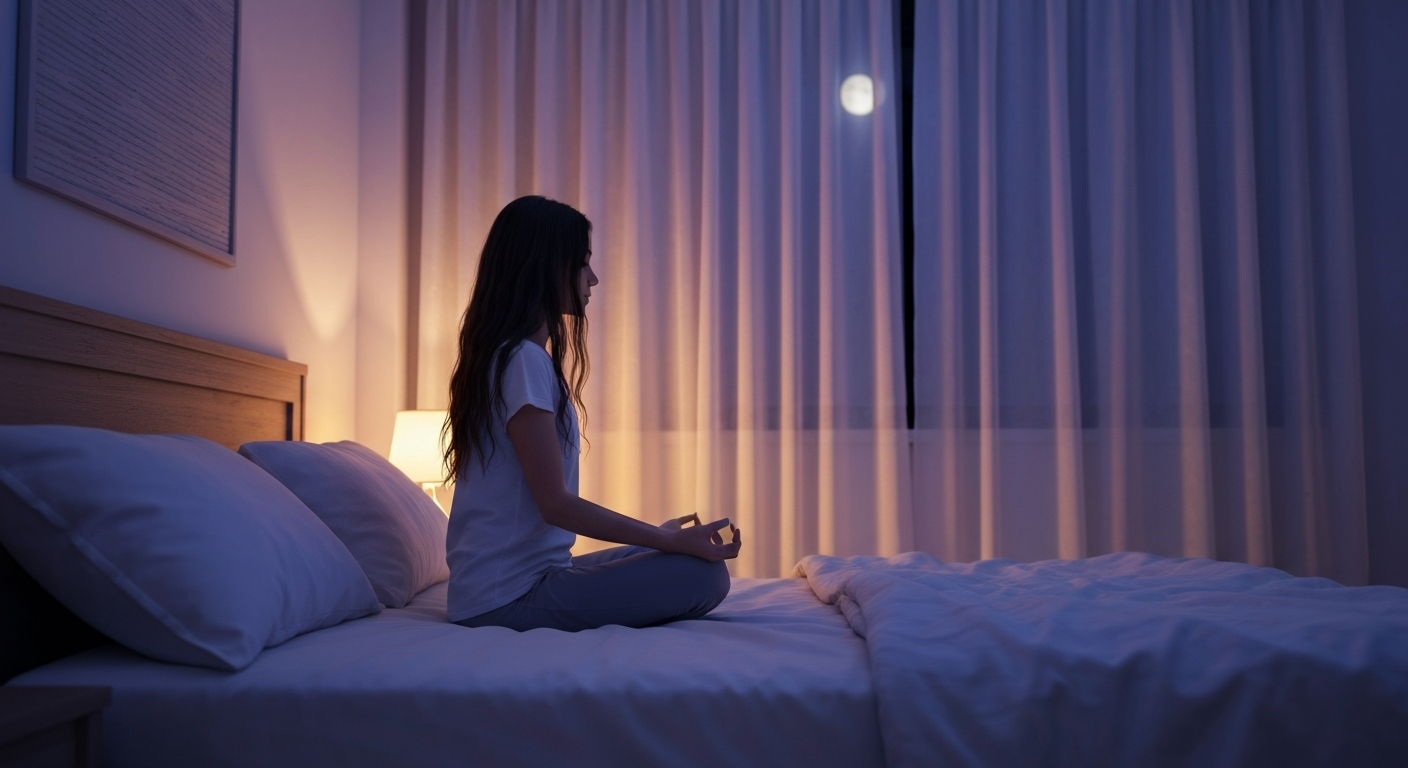
7 Sleep Meditation Techniques That Actually Work
1. The Body Scan Relaxation
The body scan is perhaps the most effective meditation for sleep. It works by systematically directing your attention through each part of your body, releasing tension you didn’t even know you were holding.
How to practice:
- Lie on your back with your arms at your sides, palms facing up
- Close your eyes and take three slow, deep breaths
- Begin at the top of your head — notice any tension, tightness, or sensation
- Slowly move your attention down: forehead, eyes, jaw, neck, shoulders
- Continue through your arms, chest, stomach, hips, legs, and feet
- At each area, consciously release any tension with an exhale
- If your mind wanders, gently return to where you left off
Most people fall asleep before reaching their feet. That’s perfectly fine — it means it’s working.

2. 4-7-8 Breathing Technique
Developed by Dr. Andrew Weil, this breathing pattern acts as a natural tranquilizer for the nervous system. The extended exhale activates your vagus nerve, which triggers the relaxation response.
How to practice:
- Place the tip of your tongue against the ridge behind your upper front teeth
- Exhale completely through your mouth
- Inhale quietly through your nose for a count of 4
- Hold your breath for a count of 7
- Exhale slowly through your mouth for a count of 8
- Repeat for 4 cycles
Start with just 4 cycles and work up from there. The ratio matters more than the speed — if counting to 8 feels too long, scale everything down proportionally.
3. Guided Visualization
Visualization gives your busy mind something peaceful to focus on instead of anxious thoughts. By engaging your imagination, you shift brain activity away from the problem-solving regions and toward the creative, restful areas.
How to practice:
- Close your eyes and imagine yourself in a place that feels completely safe and peaceful
- This might be a beach, a mountain meadow, a cozy cabin, or a childhood memory
- Engage all your senses: What do you see? Hear? Feel against your skin? Smell?
- Move through the scene slowly, noticing small details
- If anxious thoughts intrude, acknowledge them and gently return to your scene
The key is sensory richness. The more vivid and detailed your visualization, the more effectively it occupies the mental bandwidth that would otherwise fuel worry.
Free Meditation Guide
Get our 20-page beginner's guide with 5 techniques
and a 7-day meditation challenge.
No spam. Unsubscribe anytime.
4. Progressive Muscle Relaxation
This technique pairs well with meditation by first creating tension, then releasing it — teaching your body the difference between stress and relaxation.
How to practice:
- Starting with your toes, tense each muscle group for 5 seconds
- Release suddenly and notice the feeling of relaxation for 10-15 seconds
- Move up through your body: calves, thighs, glutes, stomach, chest, hands, arms, shoulders, face
- Breathe normally throughout — inhale during tension, exhale during release
The contrast between tension and release helps your brain recognize and choose the relaxed state. After a full cycle, your body feels noticeably heavier and more ready for sleep.
5. Counting Meditation
Simple but powerful. Counting gives your mind just enough to do to prevent racing thoughts, while being repetitive enough to induce drowsiness.
How to practice:
- Close your eyes and breathe naturally
- On each exhale, count: 1… 2… 3… up to 10
- When you reach 10, start over at 1
- If you lose count (you will), simply start back at 1 without frustration
The beauty of this technique is its simplicity. There’s nothing to remember, no visualization to maintain — just breathing and counting. If you’re new to meditation as a beginner, this is an excellent starting point.
6. Gratitude Reflection
Shifting your mind toward gratitude before sleep has a dual benefit: it reduces anxiety (you can’t be grateful and anxious at the same time) and it creates positive emotional associations with bedtime.
How to practice:
- Settle into bed and take several deep breaths
- Think of three specific things from today you’re grateful for
- For each one, spend 30-60 seconds really feeling the gratitude — not just thinking it
- These can be small: a warm cup of tea, a kind word from a friend, the comfort of your bed
- Let the warm feeling of appreciation wash over you as you drift off
Research from the Journal of Psychosomatic Research found that gratitude journaling before bed significantly improved sleep quality and duration.
7. Yoga Nidra (Sleep Meditation)
Yoga Nidra, meaning “yogic sleep,” is specifically designed to bring you to the threshold between waking and sleeping. It’s one of the most ancient and effective guided meditation techniques for inducing deep rest.
How to practice:
- Lie in Savasana (flat on your back, arms at sides, palms up)
- Set a gentle intention: “I will remain aware as my body falls asleep”
- Follow a rotation of awareness through your body (similar to body scan, but faster)
- Observe your breath without changing it
- Visualize simple images as they are suggested to you (a candle flame, a calm lake, stars)
- Allow yourself to hover in the space between waking and sleeping
A single 30-minute Yoga Nidra session is said to be equivalent to 2-3 hours of regular sleep in terms of restoration. While that claim is difficult to verify scientifically, practitioners consistently report feeling deeply rested afterward.
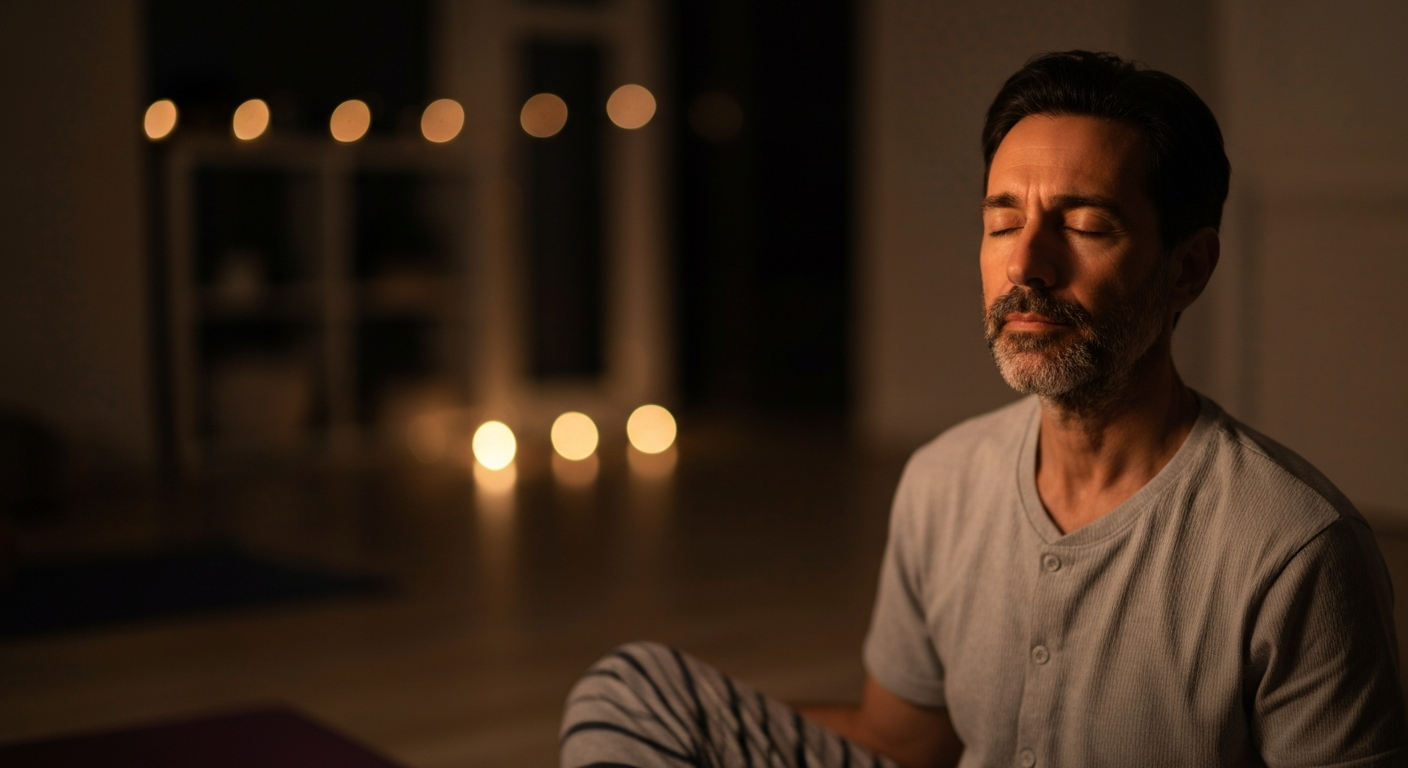
Building Your Sleep Meditation Routine
The most effective approach is consistency. Choose one or two techniques that resonate with you and practice them every night for at least two weeks before judging their effectiveness.
A suggested nightly routine:
- 30 minutes before bed: Put away all screens. Dim the lights.
- In bed: Start with 4 cycles of 4-7-8 breathing to signal your body it’s time to wind down.
- Transition: Move into either a body scan or progressive muscle relaxation.
- If still awake after 15 minutes: Switch to counting meditation or guided visualization.
Don’t pressure yourself to fall asleep — that creates the exact tension you’re trying to release. Instead, aim to rest deeply. Sleep will follow naturally.
What the Science Says
The evidence for meditation as a sleep aid continues to grow:
- A 2015 JAMA Internal Medicine study found mindfulness meditation reduced insomnia, fatigue, and depression in older adults
- A meta-analysis in Annals of the New York Academy of Sciences showed meditation significantly improved sleep quality across multiple studies
- Research from Harvard Medical School demonstrated that meditation triggers the relaxation response, lowering heart rate, blood pressure, and cortisol
- A 2019 study found that just 8 weeks of mindfulness meditation reduced time-to-sleep by an average of 20 minutes
The mechanisms are well-understood: meditation reduces activity in the default mode network (the brain’s “wandering mind” center), lowers sympathetic nervous system activation, and increases melatonin production. These effects compound over time — regular meditators show structural brain changes associated with better sleep regulation.
Common Mistakes to Avoid
- Trying too hard: Sleep meditation is passive. You’re creating conditions, not forcing an outcome.
- Using your phone: If you use a guided meditation app, set it before lying down and don’t touch the screen again. Better yet, memorize a technique and practice without technology.
- Switching techniques too quickly: Give each method at least a week of nightly practice before deciding it doesn’t work for you.
- Only meditating when desperate: Like exercise, the benefits accumulate with regular practice. Don’t wait for a crisis to start.
- Ignoring underlying issues: If severe insomnia persists despite consistent practice, consult a healthcare provider. Meditation complements medical treatment — it doesn’t replace it.
Start Tonight
You don’t need a perfect setup, special equipment, or even prior meditation experience. Tonight, try the simplest approach: lie in bed, close your eyes, and count your breaths from 1 to 10. When you lose count, start over. That’s it.
If you’d like to explore the deeper psychological benefits of meditation, or learn about mindfulness meditation as a broader daily practice, we have guides to help you build from here. You might also find that Eckhart Tolle’s teachings on presence offer a philosophical foundation for why being present — especially at bedtime — transforms sleep.
The path to better sleep doesn’t start with a pill or a perfect mattress. It starts with your breath, your awareness, and the willingness to let go — one exhale at a time.