Watch the 90-second version — the full story is below.
What Taoism Actually Teaches
Taoism (also spelled Daoism) is a Chinese philosophical and spiritual tradition built on a single insight: the universe operates according to a natural order, and the most effective way to live is to align yourself with that order rather than fight against it.
The tradition traces to two foundational texts — the Tao Te Ching attributed to Laozi (6th century BCE) and the Zhuangzi attributed to Zhuang Zhou (4th century BCE). Between them, these texts establish the core principles that have influenced Chinese culture, medicine, martial arts, and environmental thinking for over 2,500 years.
The word Tao (道) translates roughly as “the Way” — not a path you follow, but the underlying pattern of how reality unfolds. You can’t see it directly, but you can observe its effects everywhere: in the way water finds the lowest ground, in the cycle of seasons, in the way a seed becomes a tree without anyone directing the process.
Understanding these principles doesn’t require becoming a Taoist. The ideas are practical, testable, and remarkably relevant to modern challenges — from managing stress to making decisions to reconnecting with the natural world.
Wu Wei: The Art of Effortless Action
Wu wei (無為) is Taoism’s most misunderstood concept. It’s often translated as “non-action” or “doing nothing,” which makes it sound like an invitation to passivity. It’s the opposite.
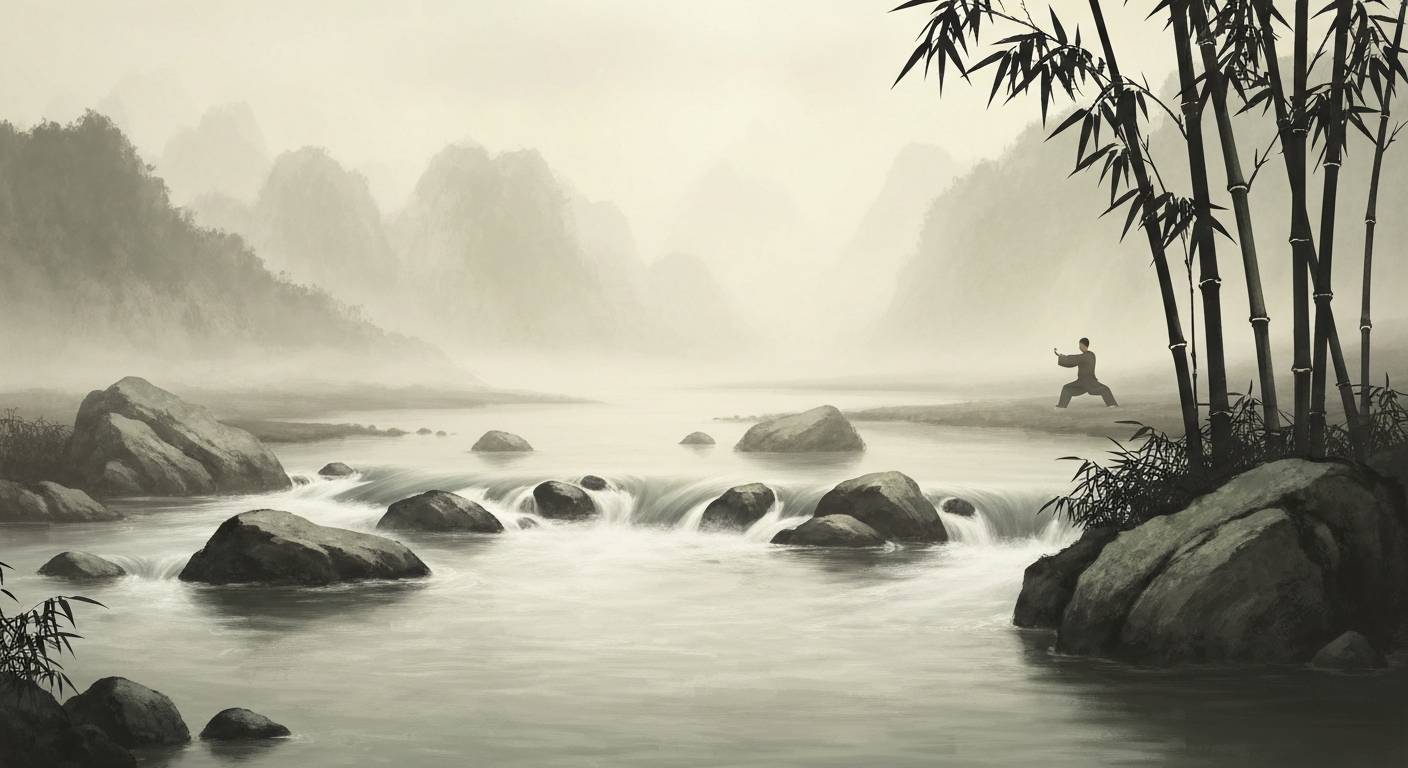
Wu wei means acting in alignment with the natural flow of a situation — doing what’s needed, when it’s needed, without forcing an outcome. A skilled surgeon’s hands move with wu wei. A good conversation flows with wu wei. A parent who knows when to intervene and when to let a child figure things out is practicing wu wei.
Laozi used water as the primary metaphor: water is the softest substance, yet it carves canyons. It doesn’t push through obstacles — it flows around them. It always seeks the lowest point, which most people avoid, yet it nourishes everything it touches.
Wu Wei in Daily Life
Practicing wu wei doesn’t mean abandoning effort. It means directing effort wisely:
- In conflict: Instead of meeting force with force, find the path of least resistance. This doesn’t mean avoiding confrontation — it means choosing the response that resolves the situation with the least unnecessary struggle.
- In decision-making: When you’re forcing a decision and every option feels wrong, wu wei suggests stepping back. The right action often becomes clear once you stop trying to control the outcome.
- In work: Flow states — when you’re so absorbed in a task that effort becomes effortless — are wu wei in action. The key is reducing the gap between what you’re doing and what the situation naturally calls for.
- In relationships: Trying to change another person is the opposite of wu wei. Accepting people as they are while clearly communicating your own needs — that’s closer to the principle.
Yin and Yang: Balance as a Living Process
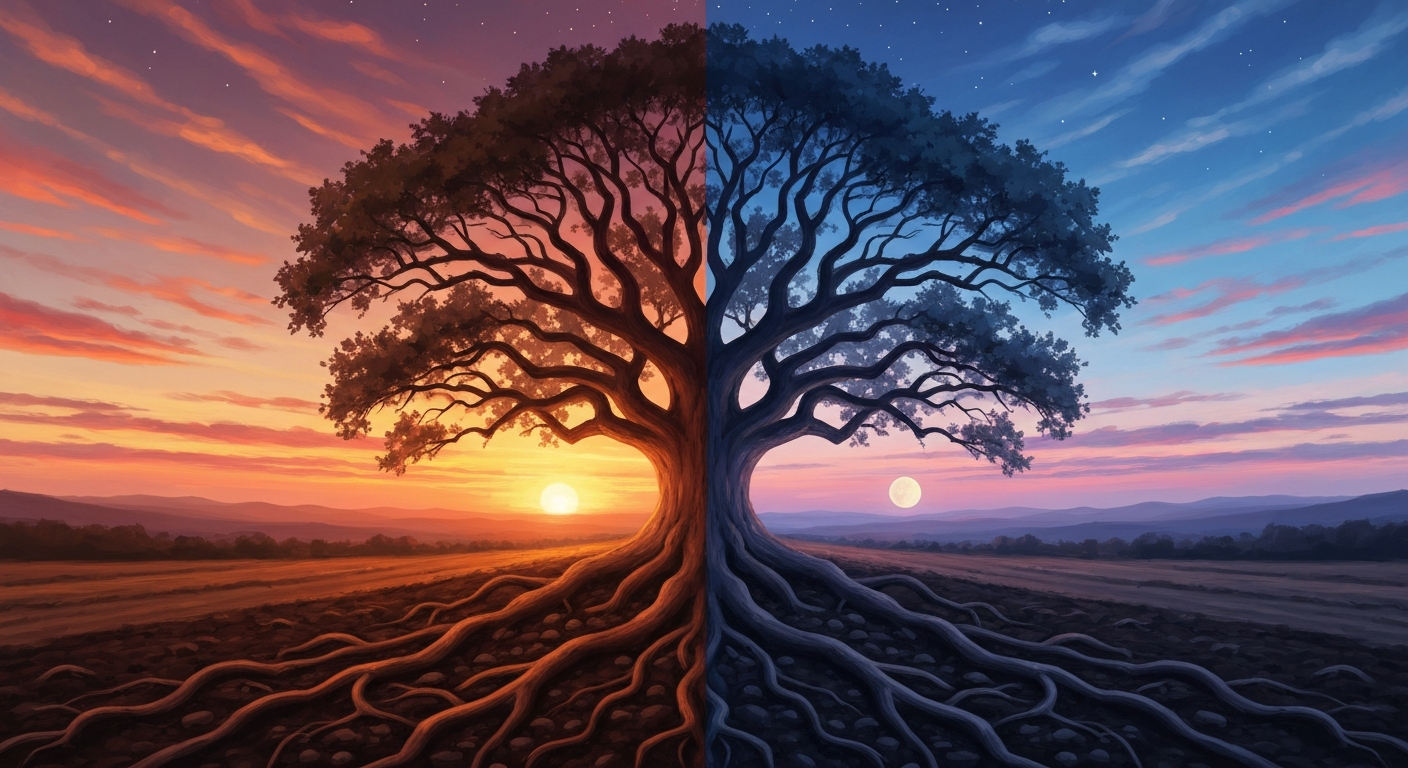
The yin-yang symbol (太極圖) represents one of humanity’s most elegant observations: all phenomena contain their opposite, and balance isn’t a fixed state but a continuous movement between poles.
Yin represents the receptive, cool, dark, and still. Yang represents the active, warm, bright, and moving. Neither is superior. Neither exists without the other. The small dots in each half of the symbol show that yin contains the seed of yang, and yang contains the seed of yin.
This isn’t abstract philosophy — it describes observable reality:
- Day contains night: The longest day of the year is the moment when days begin getting shorter. Peak yang is the birth of yin.
- Rest enables action: Sleep (yin) makes productive work (yang) possible. Cultures that glorify constant activity are ignoring half the cycle.
- Strength includes flexibility: A tree that’s too rigid snaps in a storm. A tree that bends survives. The strongest position includes the capacity to yield.
Finding Your Balance
In practical terms, yin-yang thinking is a diagnostic tool. When something in your life feels off, ask: where am I out of balance?
- Too much work (yang) and not enough rest (yin)? Burnout is coming.
- Too much planning (yang) and not enough spontaneity (yin)? Life feels mechanical.
- Too much solitude (yin) and not enough engagement (yang)? Isolation creeps in.
- Too much consumption (yin) and not enough creation (yang)? Meaning fades.
The goal isn’t perfect equilibrium — that’s a static ideal that contradicts the Taoist understanding of change. The goal is awareness of the cycle and the willingness to adjust when you’ve drifted too far in one direction.
Taoism and Nature: An Original Ecology
Long before the modern environmental movement, Taoism articulated a relationship with the natural world that was neither domination nor worship — it was participation. Humans aren’t above nature or separate from it. We’re part of the same system, subject to the same patterns.
Free Meditation Guide
Get our 20-page beginner's guide with 5 techniques
and a 7-day meditation challenge.
No spam. Unsubscribe anytime.
The Tao Te Ching returns to nature imagery constantly: water, valleys, uncarved wood, the space inside a vessel. These aren’t decorative metaphors — they’re instructions. To understand how to live, observe how nature operates.
What Nature Demonstrates
- Cycles over linearity: Nature doesn’t “progress” — it cycles. Seasons return. Seeds become trees become soil become seeds. Taoist living embraces cycles rather than demanding constant forward motion.
- Efficiency without waste: A forest ecosystem wastes nothing. Every fallen leaf feeds the next generation of growth. Taoist simplicity isn’t deprivation — it’s the recognition that excess creates burden.
- Patience as strategy: A river doesn’t hurry, yet it reaches the sea. The bamboo grows slowly underground for years, then shoots up 90 feet in weeks. Taoist timing means knowing when to wait and when to act.
- Interdependence: No organism in nature succeeds alone. The Taoist view of community reflects this — individual flourishing depends on the health of the whole system.
This perspective has made Taoism increasingly relevant in environmental discourse. The Taoist principle of living within natural limits — taking only what you need, returning what you can — is essentially the definition of sustainability, articulated 2,500 years before the term existed.
Taoist Meditation and Inner Practices
Taoist meditation differs from Buddhist mindfulness in its emphasis and goals. Where Buddhist meditation often focuses on insight into the nature of suffering, Taoist meditation focuses on cultivating and harmonizing vital energy (qi) and aligning the practitioner with the Tao.
Key Practices
Zuowang (坐忘) — Sitting and Forgetting: The practitioner sits quietly and progressively releases attachment to thoughts, sensations, identity, and eventually the sense of a separate self. The goal is to return to a state of undifferentiated awareness — the Tao itself. This practice is described in the Zhuangzi and remains central to contemplative Taoism.
Neiguan (內觀) — Inner Observation: A practice of directing awareness inward to observe the movement of qi through the body’s energy channels. This technique bridges meditation and traditional Chinese medicine, and forms the foundation of many qigong practices.
Breathing Practices: Taoist breathing emphasizes deep abdominal breathing (“breathing to the heels” as Zhuangzi describes it) that calms the nervous system and cultivates qi. The emphasis is on naturalness — the breath should be so smooth and quiet that a feather held before the nose wouldn’t move.
For those interested in exploring meditation further, our guide to beginning a simple meditation practice provides an accessible starting point. For outdoor practice inspired by Taoist nature connection, see our outdoor meditation guide.
Practical Taoist Living: 7 Principles for Modern Life
Taoism isn’t a philosophy you study — it’s one you practice. Here are seven actionable principles drawn from Taoist teachings:
- Simplify deliberately: The Tao Te Ching repeatedly praises simplicity — not as poverty, but as the removal of what’s unnecessary. Audit your commitments, possessions, and obligations. What can you release without losing anything essential?
- Move with the seasons: Align your energy with the natural cycle. Spring for new projects and growth. Summer for full engagement. Autumn for harvest and letting go. Winter for rest and reflection. Fighting this rhythm creates unnecessary friction.
- Practice strategic patience: Before forcing an outcome, ask whether the situation needs more time. Many problems resolve themselves when given space. This isn’t procrastination — it’s discernment about when action is truly needed.
- Embrace useful emptiness: Laozi observed that a cup is useful because of its emptiness, not its walls. Create space in your schedule, your mind, and your environment. Productivity culture fears emptiness; Taoism recognizes it as the source of all possibility.
- Seek the low ground: Water flows downhill, gathering strength as it goes. In Taoist terms, this means valuing humility and service over status and recognition. The person who doesn’t need to be right often has the most influence.
- Respond, don’t react: There’s a gap between stimulus and response. Wu wei lives in that gap. When provoked, pause. When pressured, breathe. The most effective response is almost never the fastest one.
- Spend time in nature daily: This isn’t optional in Taoist practice — it’s foundational. Even 15 minutes outdoors reconnects you with the patterns that Taoist philosophy describes. Walk without a destination. Sit without an agenda. Watch without labeling.
Taoism and Earth Day: An Ancient Call to Environmental Awareness
Earth Day’s core message — that humans must live in sustainable relationship with the planet — is a message Taoism has been delivering for millennia. The alignment isn’t coincidental. Many early environmental thinkers, including Aldo Leopold and Gary Snyder, drew explicitly on Taoist ideas.
The Taoist contribution to environmental thinking is distinctive in one critical way: it doesn’t frame nature as something to be “saved” or “protected” from humans. It frames humans as part of nature — participants in a system, not managers of one. Environmental destruction, in Taoist terms, isn’t just harmful to nature. It’s harmful to us, because we are nature harming itself.
Practical Earth Day practices with Taoist roots:
- Observe before acting: Before “improving” a garden, a landscape, or a system, spend time understanding how it already works. What’s the natural pattern? What happens if you do nothing?
- Take only what you need: The Taoist principle of sufficiency — enough is enough — directly counters the consumer logic of “more is better.”
- Return what you can: Composting, recycling, and regenerative practices align with the Taoist understanding that nothing in nature is waste — only resource in the wrong place.
- Connect seasonally: Plant something. Grow food. Watch the moon. These aren’t hobbies — they’re practices that rebuild the human-nature connection that modern life has severed.
For more on how ancient wisdom traditions address our relationship with the natural world, see our exploration of Buddhist principles for daily life and Roman Stoic philosophy.
Taoism’s Influence on Medicine and Martial Arts
Taoist principles didn’t remain in the realm of philosophy — they became the foundation of practical systems that billions of people use today.
Traditional Chinese Medicine (TCM) is built on Taoist concepts of qi, yin-yang balance, and the five elements. Acupuncture, herbal medicine, and dietary therapy all aim to restore the body’s natural harmony rather than attacking symptoms directly. While the evidence base for some TCM practices remains mixed, the underlying principle — that health is a state of balance, not the absence of disease — increasingly aligns with integrative medicine approaches.
Tai Chi and Qigong are moving meditation practices that embody wu wei. The slow, flowing movements are designed to cultivate qi and develop the practitioner’s sensitivity to natural timing and force. Research has shown tai chi to be effective for balance, fall prevention in older adults, and chronic pain management.
Martial arts — particularly internal styles like tai chi, baguazhang, and xingyiquan — apply Taoist principles to self-defense: use softness to overcome hardness, yield to redirect force, and act from a centered, responsive state rather than an aggressive one.
Frequently Asked Questions
What is the main belief of Taoism?
Taoism’s central belief is that there is a natural order to the universe (the Tao) and that the best way to live is to align yourself with this order rather than imposing your will against it. This manifests as the practice of wu wei (effortless action), the pursuit of balance (yin and yang), and a deep respect for the natural world as a teacher and model for human behavior.
How do you practice Taoism in daily life?
Practical Taoism involves simplifying your life, spending time in nature, practicing patience rather than forcing outcomes, and cultivating awareness of balance. It also includes meditation practices like zuowang (sitting and forgetting) and physical practices like tai chi or qigong. The essence is learning to act with the natural flow of situations rather than against them.
What is wu wei and how do you practice it?
Wu wei means “effortless action” — acting in alignment with the natural flow of a situation. You practice it by pausing before reacting, choosing the path of least unnecessary resistance, and developing sensitivity to when effort is needed and when stepping back is more effective. It’s not passivity — it’s strategic responsiveness.
Is Taoism a religion or a philosophy?
Both. Philosophical Taoism (Daojia) focuses on the teachings of the Tao Te Ching and Zhuangzi as a guide to living well. Religious Taoism (Daojiao) includes temples, rituals, deities, and an ordained priesthood. Most Westerners encounter Taoism as philosophy, but the religious tradition has been a major force in Chinese culture for over two thousand years. The two streams influence each other.
How does Taoism relate to environmentalism?
Taoism provides one of the oldest philosophical frameworks for environmental thinking. Its core principles — living within natural limits, observing before acting, recognizing human dependence on natural systems — directly parallel modern sustainability concepts. Unlike Western environmentalism, which often frames humans as separate from (and responsible for) nature, Taoism frames humans as part of nature, making environmental destruction a form of self-harm.
What is the difference between Taoism and Buddhism?
While both traditions value meditation and inner cultivation, their orientations differ. Buddhism focuses on understanding suffering and achieving liberation from the cycle of rebirth. Taoism focuses on harmonizing with the natural order and cultivating vital energy (qi). Buddhism tends toward renunciation; Taoism tends toward integration with the natural world. Historically, the two traditions influenced each other significantly — Chan (Zen) Buddhism is essentially a fusion of Buddhist meditation and Taoist naturalism.
Can Taoism help with stress and anxiety?
Taoist principles are directly applicable to stress management. Wu wei teaches non-resistance to what cannot be changed. Yin-yang thinking helps identify the imbalance causing stress (usually too much yang activity without sufficient yin rest). Taoist meditation and breathing practices activate the parasympathetic nervous system. And the Taoist emphasis on nature connection aligns with research showing that time outdoors reduces cortisol and improves mood. For specific meditation techniques for anxiety, see our meditation for anxiety guide.